FEATURED
YOUR EVERYDAY ESSENTIALS
ExPLORE
SUPPORT
DYE-FREE CLEANING
FEATURED
YOUR EVERYDAY ESSENTIALS
ExPLORE
SUPPORT
DYE-FREE CLEANING
A lot of my friends are team cleaning wipes—and swear by them. I, however, prefer a good old-fashioned cleaning spray and reusable cleaning cloth. But is either of us truly using a superior method?
The answer to "which works better—wipes or spray cleaners?" depends less on the format and a lot more on what's in the product and how you use it.
So if you're curious what the answer to this long-standing debate is, here's what the research actually says, and what it means for keeping your home clean.
Spray cleaners have been the workhorse of home cleaning long before cleaning wipes were invented—and for good reason. Multi-purpose cleaners are versatile, cost-effective, and when you choose the right formula, they're a much great option for everyday use. Here's how spray cleaners stack up.
Cleaning sprays have a practical edge when it comes to coverage. You can apply more product to a surface, saturate it properly, and reach areas a flat wipe can't—like the back of a faucet handle or the corners of a stovetop. A good spray-and-wipe routine physically removes dirt and bacteria more completely than a quick swipe, especially on larger surface areas.
Just keep in mind that the cloth you use matters, too. A reusable cleaning cloth can pick up bacteria from one surface and deposit it on the next, so a fresh cloth per surface—or folding your cloth so there are clean sections you can use—is the move for thorough cleaning.
Whether a spray cleaner is safe depends on the formulation. Most mass-market spray cleaners still use bleach, ammonia, and other harsh active ingredients, so the format doesn't automatically make this product safer.
What actually makes a difference is choosing a plant-powered cleaning spray formulated without harsh chemical actives. For everyday surface cleaning—which is what most households actually need most of the time—a well-formulated spray removes dirt and grime without leaving behind toxic residue on the surfaces your family touches all day.
Spray cleaners are significantly more economical per use than wipes, often by a factor of 5–10x. Refillable product systems bring that cost down even further while cutting single-use plastic out of the equation—which matters when you're cleaning multiple times a week, every week.
Zoom out, and you get a fuller picture of what cleaning wipes and spray cleaners each leave behind—in your home and in the environment.
Many conventional cleaning products—wipes and sprays alike—use active ingredients that don't fully break down in wastewater treatment and have been detected in aquatic environments where they're toxic to certain organisms. Bleach-based products release toxic byproducts as well. Spray cleaners formulated with plant-based surfactants, on the other hand, are usually biodegradable, making them a better choice for both your family and waterways.
The wipe itself is also worth thinking about. Most conventional cleaning wipes are made from synthetic nonwoven fabrics—like polyester and polypropylene—that don't biodegrade. They're a significant contributor to sewage blockages when flushed, and sit in landfills essentially indefinitely when thrown away.
Of course, for most home surfaces, on most days, you don't need a disinfectant at all. According to the CDC, cleaning and disinfecting are not the same thing—regular cleaning physically removes dirt and bacteria and is genuinely protective for everyday use. A plant-based multi-purpose cleaning spray handles common messes without harsh chemicals.

Both cleaning wipes and cleaning spray have a place. Here's how to determine which is the best fit for specific cleaning jobs.
Once you understand what's in most conventional cleaners, the question stops being "wipes or spray" and becomes "what's in the cleaner I'm using around my family?"
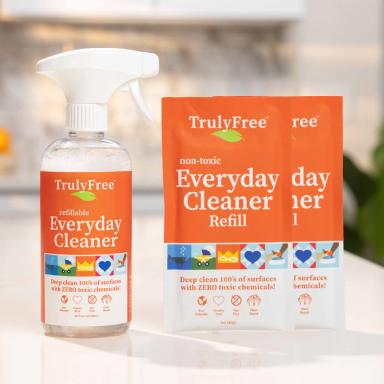
Truly Free Home Everyday Cleaner is formulated for exactly the surfaces your family touches most—kitchen counters, bathroom surfaces, stovetops—and it's powered by plant-based surfactants that lift and remove dirt, grease, and bacteria from surfaces. Plus, our Everyday Cleaner is made without harsh chemical actives, toxic fragrances, or chlorine bleach. That means it cleans your counters without leaving harmful residue behind, and you can use it daily without worrying about what you're breathing in or what your toddler is touching an hour later.
One important note: our Everyday Cleaner is not a disinfectant. It doesn't contain FDA-regulated active ingredients and doesn't make germ-kill claims. What it does is exactly what most surfaces need on most days—physically remove dirt, grease, and bacteria so they're gone.
For situations that call for disinfection—norovirus going through the house, raw meat prep, active illness—pair it with a hydrogen peroxide-based disinfectant that carries EPA registration, and follow the dwell time on the label.
For the counters you wipe down every day? A cleaner you can trust is the best call. That's what Truly Free Home was built for.