FEATURED
YOUR EVERYDAY ESSENTIALS
ExPLORE
SUPPORT
DYE-FREE CLEANING
FEATURED
YOUR EVERYDAY ESSENTIALS
ExPLORE
SUPPORT
DYE-FREE CLEANING
Formaldehyde is a colorless gas with a strong, distinctive odor. At room temperature, it easily becomes airborne, which is why it's classified as a volatile organic compound (VOC). When products containing formaldehyde release it into your home's air, that process is called off-gassing.
You won't always smell it, either. Formaldehyde can be present at levels high enough to cause health effects before it becomes noticeable. According to the EPA, some people experience adverse effects at concentrations as low as 0.1 parts per million.
Formaldehyde is used widely in manufacturing, which means it ends up in a surprising range of household products. According to the Agency for Toxic Substances and Disease Registry (ATSDR), common sources include:
Building materials are often the biggest culprits, especially composite wood products made with urea-formaldehyde resins. Cleaning products and laundry detergents can also contribute to indoor formaldehyde levels, particularly when used frequently in enclosed spaces.
Indoor air also typically contains higher formaldehyde concentrations than outdoor air. The EPA notes that homes with new furniture, recent renovations, or poor ventilation tend to have elevated levels of this toxin.
Short-term exposure to formaldehyde can cause a range of adverse health effects, including:
Higher concentrations can trigger asthma attacks in sensitive individuals. Children, older adults, and people with respiratory conditions are particularly vulnerable.
Long-term exposure is where the more serious concerns come in. In January 2025, the EPA released a final risk evaluation determining that formaldehyde poses an "unreasonable risk of injury to human health" through both inhalation and skin contact.
Both the International Agency for Research on Cancer (IARC) and the National Cancer Institute classify formaldehyde as a known human carcinogen. The IARC placed it in Group 1, the highest classification, based on sufficient evidence that it causes nasopharyngeal cancer in humans, with additional evidence linking it to leukemia and sinonasal cancers.
The good news is you have control over many of the formaldehyde sources in your home. Here are practical steps to reduce your family's exposure:
Read product labels carefully. Look for formaldehyde or formaldehyde-releasing ingredients—like DMDM hydantoin or Quaternium-15—in cleaning products, laundry detergents, and personal care items. Keep in mind that formaldehyde isn't always listed directly. It can be released by other ingredients during use or storage. Common synonyms for formaldehyde found on labels also include: methanal, formalin, methyl aldehyde, methylene oxide, oxymethylene, and methylene glycol.
Choose products with full ingredient transparency. Companies that disclose everything in their formulas make it much easier to avoid hidden, harmful chemicals. If a brand won't tell you what's in their product, that should raise a red flag.
Ventilate well. Open windows when cleaning, and ensure good airflow in rooms with new furniture or recently installed flooring. Fresh air helps dilute formaldehyde concentrations in cleaning products when using them indoors.
Air out new items. New furniture, especially pieces made with pressed wood or MDF, can off-gas formaldehyde for weeks or months. If possible, let new items air out in a garage or well-ventilated space before bringing them into the main living areas.
Wash new fabrics before use. The ATSDR recommends washing new permanent-press clothing and linens before wearing or using them. This helps reduce leftover formaldehyde residue from the manufacturing process.
Look for low-emission certifications. When shopping for furniture or building materials, look for labels indicating TSCA Title VI compliance, CARB Phase 2 compliance, or "no-added formaldehyde" (NAF) and "ultra-low-emitting formaldehyde" (ULEF) certifications.
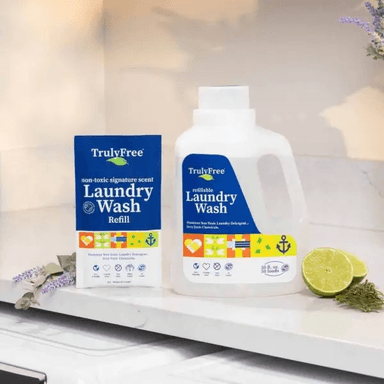
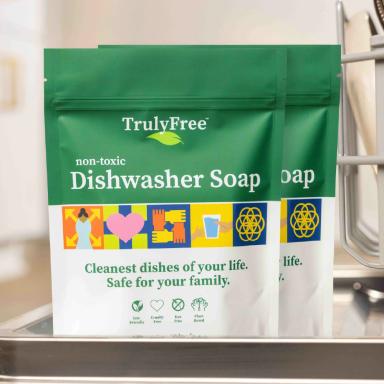
At Truly Free Home, we believe you shouldn't have to wonder what's in your cleaning products or worry about what they're releasing into your air. Every product we make, from our Laundry Wash and Dishwasher Soap to our surface cleaners and Space Freshener, is formulated without formaldehyde or other toxic chemicals.
Our plant-based formulas are tough on dirt and gentle on your home. Full ingredient transparency means you always know exactly what you're using around your family.