FEATURED
YOUR EVERYDAY ESSENTIALS
ExPLORE
SUPPORT
DYE-FREE CLEANING
FEATURED
YOUR EVERYDAY ESSENTIALS
ExPLORE
SUPPORT
DYE-FREE CLEANING
Since residue from conventional laundry detergents stays on fabric even after it’s washed, every time you wear a shirt, sleep on your pillowcase, or dry off with a towel, your skin is in direct contact with whatever your detergent left behind. For most people, this isn't noticeable. But for people with eczema or sensitive skin, laundry detergent residue can cause itching, redness, dryness, and painful flare-ups.
This type of reaction is often contact dermatitis, an inflammatory skin response triggered by an external irritant. It's different from eczema because it's caused by a specific substance touching the skin. However, for people with eczema, contact dermatitis from laundry products can make existing symptoms significantly worse.
Not all ingredients are equally problematic, but these are most frequently linked to skin reactions. Knowing what to look for on a label makes shopping much simpler.

"Hypoallergenic" isn't a regulated term, so the label alone doesn't guarantee anything. That’s why the ingredient list matters. When shopping for laundry soap for sensitive skin or eczema, look for fragrance-free formulas (not just "unscented") that also don’t include SLS, optical brighteners, and artificial dyes.
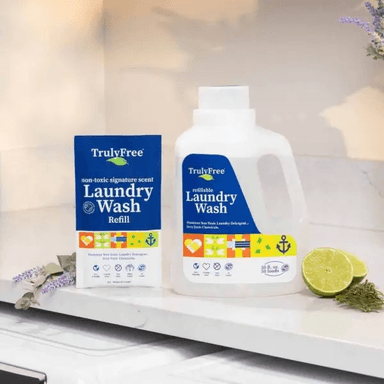
Detergents that use bio-based enzymes to break down stains and odors are your best bet for sensitive skin because enzymes do the cleaning work without relying on harsh surfactants or harmful chemicals. Truly Free Home Unscented Laundry Wash checks all of these boxes. Our formula is never made with fragrance, SLS, optical brighteners, or dyes. And we provide a full ingredient list on every bottle.
Detergent gets most of the attention, but fabric softeners and dryer sheets are often the bigger problem for eczema-prone skin. Both products work by coating fabric fibers with a thin layer of silicone, which is exactly why they make clothes feel soft. The downside is that coating stays on the fabric and presses against your skin for hours, which can cause irritation.
Conventional fabric softeners and dryer sheets are also typically loaded with harsh fragrance chemicals, which are known skin irritants. For sensitive skin, the simplest move is to skip them entirely. If you want softer laundry, try wool dryer balls as a fragrance-free, residue-free alternative.
In addition to switching laundry products, there are a few easy laundry habits that can reduce the potential for skin irritation:
If laundry day is making your skin worse, start by reading your laundry product labels. Most people never think to check what's actually in their detergent, fabric softener, or dryer sheets. But your clothes are against your skin all day, so whatever's in that wash cycle comes with them.
Swapping to a cleaner detergent, like Truly Free Home Non-Toxic Laundry Detergent, and ditching conventional fabric softener and dryer sheets can seriously cut down on your daily chemical exposure. It's one of the simplest changes you can make. And for sensitive skin, it's often one of the most noticeable.