FEATURED
YOUR EVERYDAY ESSENTIALS
ExPLORE
SUPPORT
DYE-FREE CLEANING
FEATURED
YOUR EVERYDAY ESSENTIALS
ExPLORE
SUPPORT
DYE-FREE CLEANING
Here's something most people don't know: modern dishwashers are built to handle food residue. In fact, they need it to work properly.
Most dishwashers manufactured after the early 2000s include soil sensors—basically tiny detectives that measure how dirty your dishes are at the start of each cycle.
When you pre-rinse everything until it's spotless, those sensors get confused. They think your dishes are already clean, so the dishwasher switches to a lighter wash cycle.
The result? Your "clean" dishes come out with invisible residue, stuck-on food particles, or that weird cloudy film on your glasses.
Want to know if your dishwasher has soil sensors? Find your model number on the inside of the door or in your user manual, then look it up on the manufacturer's website. Most models from the last 20 years have them.
Think about it like this: dishwasher detergent is like a search-and-destroy team. The enzymes in the formula are specifically designed to break down grease, starches, and proteins.
But if there's nothing to break down?
Those enzymes have nowhere to go. The detergent just rinses away without doing its job.
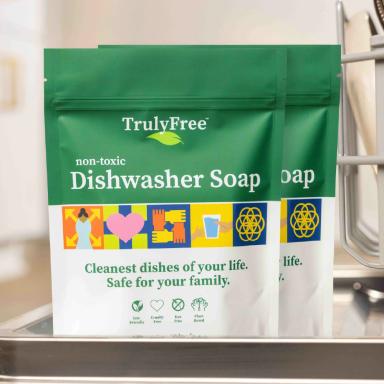
Truly Free Home's Dishwasher Soap uses powerful plant-derived enzymes that actually need food particles to cling to. That's how they carry away the grime and leave your dishes spotless—without any toxic chemicals touching the surfaces your family eats from.
When you pre-rinse, you're robbing your detergent of the chance to do what it was formulated to do.
Here's the math that changed my mind forever:
According to Consumer Reports, you waste between 1.7 and 6 gallons of water for every minute you run the faucet to pre-rinse.
Let's say you spend just 2 minutes rinsing dishes before loading the dishwasher. That's up to 12 gallons per load.
Compare that to an Energy Star-certified dishwasher, which uses as little as 3 gallons for an entire cycle.
You're using four times more water to pre-rinse than your dishwasher needs to wash everything.
And if you're doing dishes every night? That's thousands of gallons wasted every year.
Okay, so we're not pre-rinsing anymore. But that doesn't mean you throw a plate covered in spaghetti sauce straight into the dishwasher.
Here's what to do instead:
Use a spatula, paper towel, or your garbage disposal to scrape off large chunks of food. That's it.
You're not trying to make the plate look clean. You're just removing anything that could clog the drain or get stuck in the spray arms.
Think:
Everything else? Let the dishwasher handle it.
There are exactly two situations where a quick rinse makes sense:
1. You Have an Older Dishwasher (Pre-2000s)
If your machine doesn't have soil sensors and struggles with tough loads, a light rinse on heavily soiled dishes can help. But even then, you're better off upgrading to Truly Free Home's Dishwasher Booster & Rinse Aid instead of pre-rinsing.
2. Dishes Are Sitting Overnight
If food is going to dry and cake onto the plate before you run the dishwasher, give it a quick rinse or soak. Dried-on egg yolk or cheese is much harder for any detergent to break down.
But for same-day loads? Skip the rinse entirely.

If you're skipping the pre-rinse, loading matters more than ever. Here's how to do it right:
Your dishwasher's spray arms shoot water from the center outward. Position plates, bowls, and pans so the dirtiest surfaces face inward, where the water pressure is strongest.
I know it's tempting to Tetris every dish into one load, but overcrowding blocks water flow. If dishes are touching or overlapping, the detergent can't reach every surface.
Leave a little breathing room.
Bottom rack: Pots, pans, large plates, serving dishes—anything that needs serious cleaning power.
Top rack: Glasses, mugs, small bowls, plastics, and anything delicate. The water pressure is gentler up top.
Alternate spoons and forks handle-up and handle-down. If they nest together (like spoons inside spoons), they won't get clean.
Make sure tall items like baking sheets or cutting boards aren't blocking the spray arms. If the arms can't spin, nothing gets clean.
One more thing most people don't realize: conventional dishwasher detergents leave behind toxic residue that reactivates every time you use that plate.
Chlorine. Phosphates. SLS. Synthetic fragrances.
These chemicals don't rinse clean. They stick to the surface of your dishes, and when you put hot food on that plate or pour coffee into that mug, those toxins leach right back into what you're eating and drinking.
That's why we created Truly Free Home Dishwasher Soap with zero toxic chemicals. Just plant-based enzymes, natural salts, and minerals that break down food and rinse completely clean.
No residue. No chemicals. Just dishes that are actually safe to eat from.
Modern dishwashers are engineering marvels. They're designed to be more efficient, use less water, and clean more effectively than hand-washing ever could.
But only if we let them do their job.
So here's what I want you to try:
Tonight, scrape your dishes and load them straight into the dishwasher—no pre-rinsing. Use one full scoop of Truly Free Home Dishwasher Soap (or add Dishwasher Booster & Rinse Aid if you have hard water or an older machine).
Run the cycle.
Then check your dishes.
I'm betting they come out cleaner than they have in years. And you'll have saved 10 gallons of water, 5 minutes of your time, and avoided toxic chemical exposure in the process.